
About Us
Information about VIU Library, collections, assessment, and key documents.
Library information
Situated on the traditional territories of the Coast Salish Peoples, the Vancouver Island University (VIU) Library supports learning, teaching and research needs at the University’s three campuses and beyond. The Library is known as a leader for consistently identifying, leveraging, and advancing strategic local, regional, national, and international collaborations, for both institutional and collective benefit.
We are committed to supporting the values of equity, diversity, and inclusion by promoting a welcoming and inclusive environment for all. We recognize the library’s important role in promoting a culture of safety and respect on campus, and we will continue to reflect on and reevaluate our space and services to remove barriers and meet the needs of individuals in the VIU community.
The Nanaimo campus library is visited more than 500,000 times by members of the VIU community each year. To accommodate the various needs of users, this space currently includes:
- 199 computer workstations
- 585 seats
- 7 group study rooms
- 3 media workstations
- 2 video/audio editing rooms
- 2 silent study spaces with 22 seats each
- Other support services, such as the VIU Writing Centre, IT Technology Support, and Centre for Innovation and Excellence in Learning (CIEL), are conveniently co-located with the Nanaimo campus library.
Learn more about the Nanaimo Campus Library Commons and Library Space.
The Cowichan campus library in downtown Duncan, BC, the traditional territory of the Quw'utsun First Nation, shares space in a LEED® Gold Certified building with other teaching and learning partners. As a Learning Commons partner, the library provides 84 seats, a silent study room, four group study rooms and a media editing room, a 10,000-volume print collection, and a full suite of circulation, equipment loan, research help, library instruction and technical help services.
The tiwšɛmawtxʷ library serves a small but connected community of learners. Primarily a digital library, tiwšɛmawtxʷ library houses a small print collection of core academic and local-interest materials, four computer workstations and tables for quiet individual and group study. The library is run in partnership with campus staff, who assist with circulation and referrals. Full library services including course reserves, interlibrary loans, research help and library instruction are provided online and during site visits.
Since its beginnings in 1969, the Library has evolved in response to the changing needs of the broader VIU community, demonstrating a consistent willingness to reimagine library work and adapt to changing realities. This work has included the adoption of new library technologies, evolving outreach, assessment, staff roles, and major renovations.

The Nanaimo campus library’s last major renovation project was completed in 2005, resulting in a newly improved, 100,000-square-foot space.

A second major renovation project took place in the 2019/20 fiscal year, responding to consistent feedback from the VIU community over the last decade. The project introduced several improvements to the third floor of the Nanaimo campus library to increase the amount of space in the Learning Commons, allowing for secure late night access to the third and fourth floors, the introduction of a dedicated family space, additional computer stations, collaborative spaces, and individual carrels.
Artwork in the library
The following is part of the artist's statement prepared by Eliot White-Hill, Kwulasultun, for installations located at the Nanaimo campus library.
"Lhuxw 'u tu Snuw'uyulh" (Flow of the Teachings)
This installation is an expression of the traditional flow of knowledge and teachings from generation to generation. It is about honouring the work done by my late great-grandmother, Dr. Ellen White, Kwulasulwut, as an elder in residence, and my grandmother, Joyce White, Sa'lay'wi'ah, for her critical role in creating the Xwulmuxw (Indigenous) Studies program. These murals are my own artistic rendering drawing upon traditional Coast Salish style and imagery. The two murals “Lhuxw (Flow)” and “Matriarch Moon” come together to form the telling of this story. The imagery of the night sky, the stars, and the “flow" of the Milky Way is drawn from the meaning of my late great-grandmother's name “Kwulasulwut” which means “Many Stars” and is a beautiful image of the gifts she gave so many. I am honoured to have the opportunity to share Coast Salish art at the VIU Library and to share the wealth of Snuneymuxw culture and tradition with all visitors to this place. I hope to blanket and honour future generations of Snuneymuxw with this art as they do the sacred work to learn.
"Matriarch Moon"
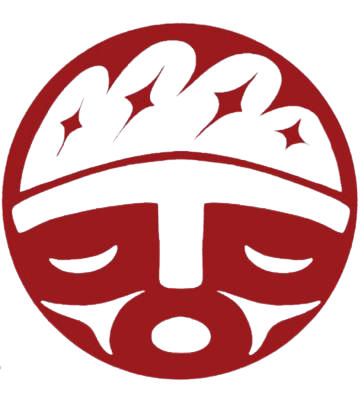
This mural, at the fireplace, is a centering of the flow honouring Snuneymuxw Matriarchs and the profound impact they have had at VIU and in our community, in particular my grandmother, Joyce White, Sa’lay’wi’ah, for her work with the creation of the Xwulmuxw (Indigenous) Studies program, and my late great-grandmother, Dr. Ellen White, Kwulasulwut with her work as an Elder in Residence. The stars throughout are a reference to the name that my great-grandmother carried “Kwulasulwut” which means “Many Stars.” These stars are the gifts she gave to so many through her lifetime of work, and draw upon the milky way of our teachings. The Matriarchs of our families have given us everything.
"Lhuxw" (To Flow)
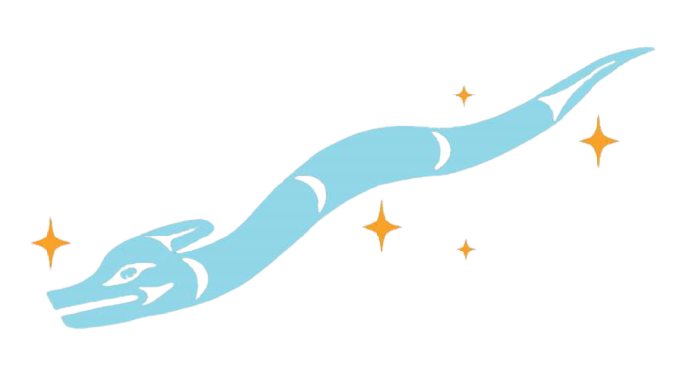
This mural is a depiction of serpents in the flow. They are supernatural beings and guardians of the river here in Snuneymuxw. They represent the teachings, the words that we speak, the stories that we tell, and the love that our ancestors have for us. There is a juxtaposition of symbolism in the imagery, drawing inspiration from my Liberal Studies education, and how serpents represent very different things in Western and Coast Salish tradition. The serpent is what gave the apple of knowledge which caused humans to be cast from the Garden of Eden, it is seen as a malevolent being. Whereas in Coast Salish tradition they are powerful helpers who can benefit or harm us, but they are not seen as malevolent or benign, they exist outside of morality. With that reference, I prod at the eurocentrism of academia and promote decolonization of education.
— Eliot White-Hill, Kwulasultun
Harold Louie Joe was born in Cowichan and spent his childhood in Musqueam. His maternal grandfather was a mask and bent box carver, and his paternal grandfather was a totem pole carver and canoe builder. Inspired by the “silent inspiration” of his grandfather’s nods when he was a child, he began his craft at twelve years old.
Directed by the voices and whispers of his grandparents and ancestors, Harold Joe recognizes the impact and importance of respecting the place that all living beings have in this space. Finding the perfect cedar tree, for example, doesn’t take directions or maps, but instead explains that “[finding a cedar tree is] like a gift… it drew us there.”
Using tools that include carving knives, axes, and chainsaws, Harold Joe does not just create life from the flesh of cedar trees, he continues it. Cedar, he explains, has a “strong soul” that “makes life” for each human being. He offers prayer to the cedar tree, and shares conversation with it, listening to its lessons, following the whispers of those who came before, and breathing life back into it. As Joe continues to create and share his art with local communities and beyond, Joe frequents his work as a means to remind himself where he came from, and breathe “where the memories are.”
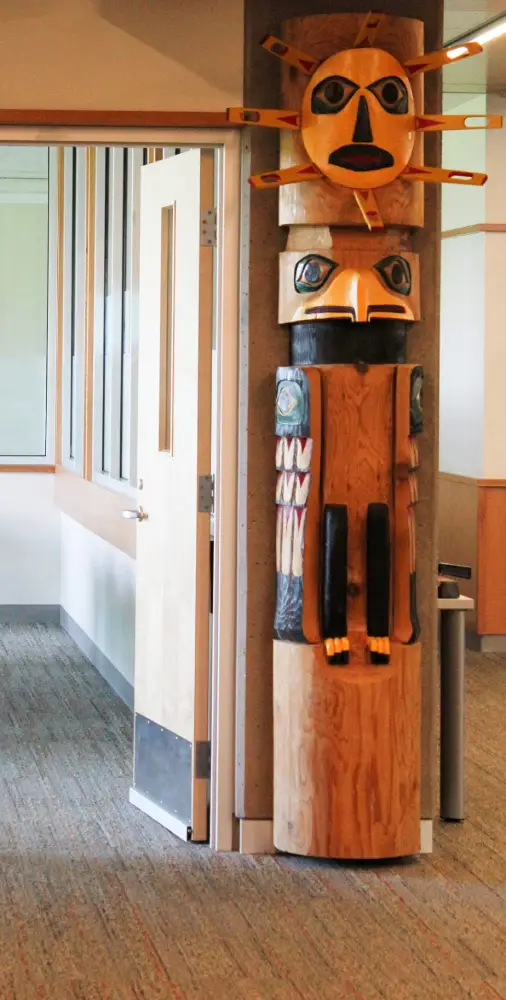
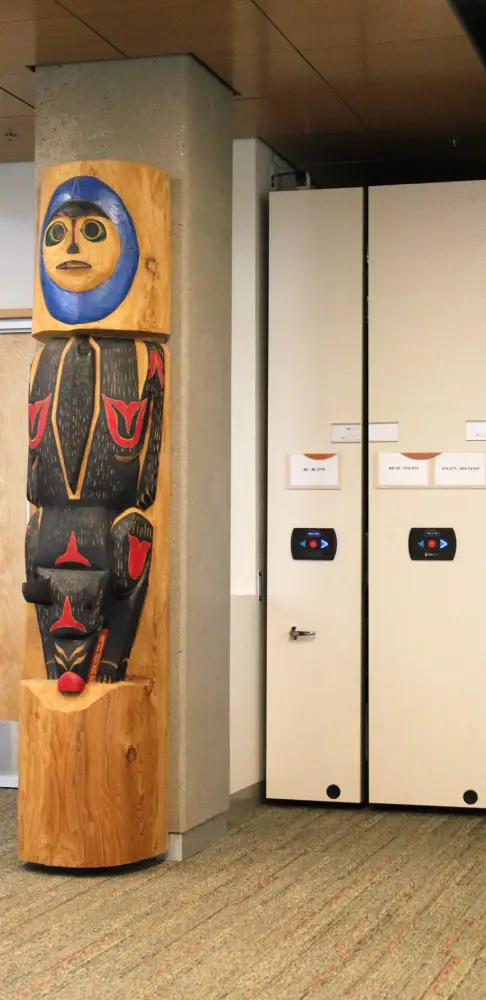
"Thunderbird and the Sun” and “Moon Above Wolf”
“Thunderbird and Sun” and “Moon Above Wolf” totems are located in the Library and Learning Commons at the Vancouver Island University Cowichan Campus. As Joe explains, “students are the greatest gift from Mother Earth to the World, and the placement of the totems encourages students to appreciate their meaning and feel at home in their learning environment.”